
Local Leader Spotlight
Bridging Data, Youth Stories, and Community Wisdom: An Interview with Mark Comesañas
By Margaret Goldman
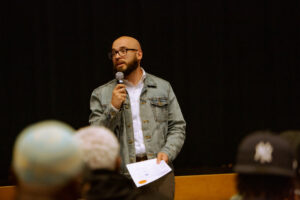
I had the opportunity to sit down with third-generation Newarker and long-time local leader, Mark Comesañas. Adding to the many roles he has played for the city – a teacher and alternative high school founding team member, a school administrator, and the Executive Director of My Brother’s Keeper-Newark – Mark was recently elected to Newark’s School Board. We spoke about how he approaches the intersection between research and local leadership in public education. Throughout our conversation, Mark highlighted the importance of research-driven decision-making but emphasized the delicate balance between ‘data’ and lived experience. To clarify this balance, Mark shared the story of Jose:
Two weeks ago, I was on a panel for an event, and I shared the story of a young man, Jose; when I met Jose, he was 19 years old and he could not read. I told that story in that moment, because what I was trying to posit was: what is informing our decision to pick up with third grade literacy as an issue? And I was saying that Jose’s story informed that, because the options Jose has as a 19-year-old struggling reader are much [slimmer] than if he was actually reading on grade level. What bothered me is that several media outlets and some political pundits took that as an opportunity to take a stab at the school district to say, “all this money and Jose still can’t read.”
For Mark, the perspectives and lived experiences of Newark’s youth must guide not only the decisions we make but how we interact with the data that can inform those decisions. He insightfully captured how while data and statistics are crucial in guiding our educational agendas, they cannot stand in for the complexity, nuance, and evolution of young people’s lives.
What I was also bothered by was the fact that folks took this much information and created an entire narrative that was just not even the actual true story and full story. Because if I had told the full story of Jose they would have known that he came here from the Dominican Republic when he was in his early teens. He lived in multiple cities because of economic hardship, that by the time he [came to our school], he had just gotten to the city of Newark. And when Jose left us…he was actually reading at a 5th grade level. Which is amazing in three years.
In this case, the fullness of Jose’s story—in beauty, hardship, and growth—was eclipsed by single statistic taken out of context. For Mark, then, the role of research is not simply defining or quantifying a problem, but creating a point of departure for youth and communities to connect their lived experiences to broader issues.
…and so to me, that’s where it all kind of intersects, is that the research expertise and perspective coupled with the community expertise and perspective, with the educators’ expertise and perspective, with the young person’s expertise, like, all of that comes together to actually provide a real, more robust story of how to get to the outcomes that we all care about.
To capture this, he shared another story about a workshop he held with ninth-graders at a Newark comprehensive high school. He presented data from Cornwall’s Freshman-On-Track research, which shows that how well a student performs their freshman year is one of the strongest indicators of graduation.
Those young people were sitting on the edge of their seats, looking at this research and data about them, about their lived experience, and were contributing to all the ways that that made sense or didn’t make sense for them.
These sorts of experiences directly inform how Mark intends to use research in his new role as School Board member. His approach
…is to not take that data and try to make sense of it and then say to community, “Hey, here’s how we’ve made sense of this data.” But instead to actually give that information to community and say, “How does this make sense to you? Does it even make sense to you?”…There’s a level of wisdom that community members have that you just can’t glean from a spreadsheet.
Concluding with a final piece of insight, Mark offered that educators, researchers, and local leaders should all share a common goal: not to be the experts who tell others what they need, but to create the conditions in which the wisdom that already exists within youth and communities can bubble to the surface.