
New Jersey Mathematics Hub
What is the Mathematics Hub?
The New Jersey Mathematics Hub is a collaborative statewide initiative led by the Joseph C. Cornwall Center for Metropolitan Studies in partnership with Rutgers University–Newark’s Department of Urban Education. Together, we aim to strengthen mathematics teaching and learning by building on the expertise, commitment, and creativity of New Jersey’s educators, families, and communities through collaborative learning networks and partnerships that leverage local, state, and national best practices and models.
The Rutgers–Newark Math Hub cultivates spaces where practitioners, researchers, policymakers, and community members learn with and from one another, examining problems of practice, sharing promising strategies, and co-designing solutions grounded in community strengths and rigorous research.
Why are we building it?
While 40.2% of students met proficiency standards in 2023–2024, including 20.1% of Black and 24.2% of Latine students, these results point not only to persistent inequities but also to the urgent opportunity to expand access to high-quality instruction and meaningful learning experiences for all young people.
What is our vision?
Over time, the Hub will grow into a sustained statewide resource that strengthens alignment across systems, generates actionable evidence for families, educators, and policymakers, and supports continuous improvement in mathematics teaching and learning. Our aim is to cultivate a broad movement in which Black, Brown, and low-income children and communities are fully engaged, supported, and recognized as powerful mathematical thinkers prepared for 21st-century opportunities.
Contact Information
Interested in learning more about NJ Math Hub or exploring a potential collaboration? We’d love to hear from you. Whether you’re a student, educator, researcher, or community organization looking to partner on a project, feel free to reach out to us at nj.mathhub@newark.rutgers.edu. We’ll get back to you as soon as possible.
Experts



-
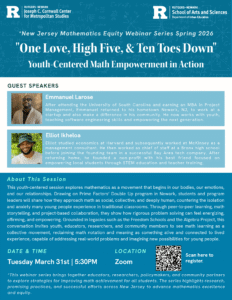
Rutgers NJ Math Hub Webinar 1: Youth-Centered Math Empowerment in Action
We hosted the first session in the New Jersey Mathematics Equity Webinar Series. The event took place on Zoom on Tuesday, March 31st at 5.30 pm.
This youth-centered conversation explored mathematics as a collective movement. Drawing on Prime Factors’ Double Up program in Newark, students and program leaders shared how they approach math as social, collaborative, and deeply human, countering the isolation and anxiety many young people experience in traditional classrooms.
Grounded in the legacies of the Freedom Schools and the Algebra Project, this webinar explored what it means to reclaim math notation and meaning as something alive and connected to lived experience capable of addressing real-world problems and imagining new possibilities for young people.
-
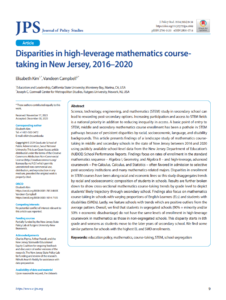
- Disparities in High-Leverage Mathematics Course-Taking in New Jersey, 2016-2020
This study of New Jersey schools (2016-2020) finds that students in racially and economically segregated schools have substantially less access to advanced math courses, with gaps beginning in middle school and widening through high school.
Kim E, Campbell V. Disparities in high-leverage mathematics course-taking in New Jersey, 2016–2020. J. Policy Stud. 2024;39(4):9-34. https://doi.org/10.52372/jps.e669
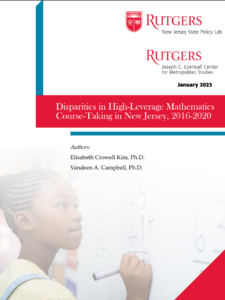
- Disparities in High-Leverage Mathematics Course-Taking in New Jersey, 2016-2020 – Report
This report presents findings of a study of mathematics course-taking in middle and high schools in the state of New Jersey between 2016 and 2020.
Kim, Elisabeth & Campbell, Vandeen. 2023. Disparities in High-Leverage Mathematics Course-Taking in New Jersey, 2016-2020. New Jersey State Policy Lab. New Brunswick, NJ: Rutgers University.
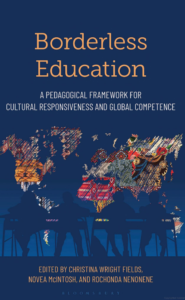 Collaborative Mathematical Endeavors as Pillars of Global Education
This chapter addresses the global interconnection of educational challenges, emphasizing the importance of equitable social and economic opportunities. It presents an example of a challenge to the conventional nationalist approach to international education, advocating instead for a commitment to global justice.
Powell, A., Haydar, H., & McGlone, C. (2026). Collaborative mathematical endeavors as pillars of global education. In C. Wright Fields, N. McIntosh, & R. Nenonene (Eds.), Borderless education: A pedagogical framework for cultural responsiveness and global competence (p. 61). Bloomsbury Publishing USA.
 Enhancing Students’ Fraction Magnitude Knowledge: A Study with Students in Early Elementary Education
The idea of magnitude is central to understanding fractional numbers. To investigate this relationship, we implemented a design research project in an urban school in the northeast of the US to examine the potential of a measuring perspective and the mathematical notion of fraction-of-quantity to enhance second-grade students’ conceptual understanding of fraction magnitude. We used ideas from the history of mathematics and mathematics education within a cultural-historical framework to define fractions and construct tasks.
Powell, A. B. (2023). Enhancing students’ fraction magnitude knowledge: A study with students in early elementary education. The Journal of Mathematical Behavior, 70. https://doi.org/10.1016/j.jmathb.2023.101042